Mark Carney Suspends US Trade Talks Defends Canadian Sovereignty
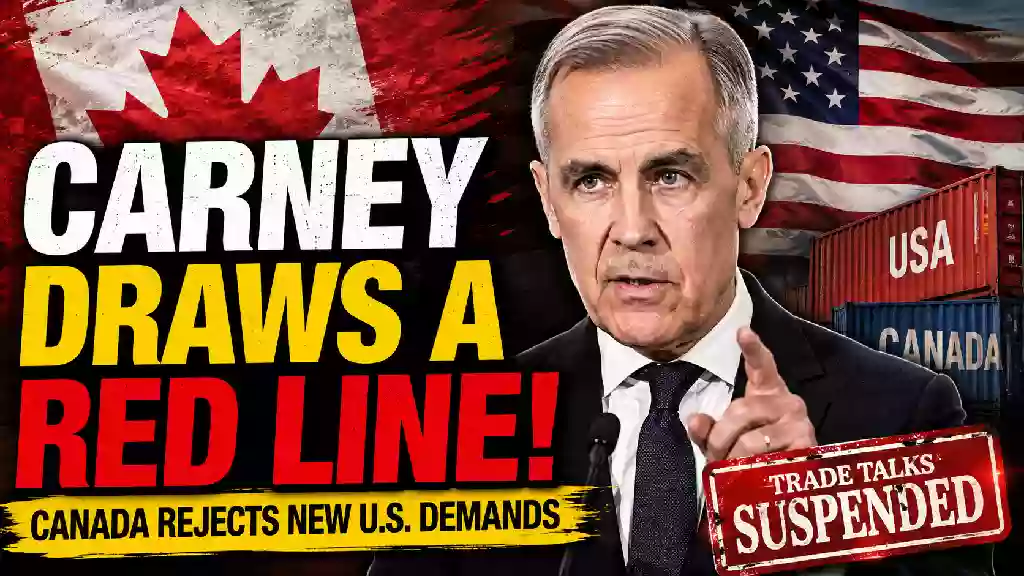
Mark Carney draws a red line in U.S.-Canada trade negotiations as Canada suspends talks over new U.S. demands, citing concerns over economic fairness and Canadian sovereignty.
Mark Carney Suspends US Trade Talks Defends Canadian Sovereignty
Carney Draws a Red Line as Canada Suspends US Trade Talks Over New Demands
Canadian Prime Minister Mark Carney has drawn a firm line in trade negotiations with the United States, suspending talks after rejecting new American demands that Ottawa says are unfair, economically damaging and incompatible with Canadian interests.
After more than a year of negotiations, Canada had hoped to reach a comprehensive trade agreement that would protect Canadian workers, strengthen the economy and provide greater certainty for businesses on both sides of the border. Instead, the latest U.S. proposals pushed the negotiations to a breaking point.
Carney’s message was clear: Canada remains willing to negotiate, but it will not sacrifice its sovereignty or key national interests to secure a deal.
Carney Rejects New U.S. Demands
Canada had spent more than a year pursuing a new trade agreement with Washington, describing its approach as pragmatic, patient and persistent. The objective was to establish a deal that would protect Canadian workers and their families while respecting Canada’s sovereignty.
According to Carney, recent U.S. proposals fundamentally changed the direction of the talks.
Canada had believed earlier in the week that negotiations were moving toward a mutually beneficial agreement. That changed when Washington presented new terms that Ottawa considered economically unworkable and unfair.
Carney said the proposals undermined the potential benefits of an agreement and raised questions about the reliability of any future deal.
Canadian Sovereignty Remains Off the Table
The biggest sticking point was not simply tariffs or individual industries. Carney emphasized that Canada would not compromise on its sovereignty.
Ottawa was also unwilling to undermine key Canadian industries or weaken protections involving the French language and Canadian culture. Those issues, Carney said, were never part of Canada’s negotiating position, even as the United States continued pressing its demands.
That position gives the dispute a significance beyond the immediate tariff negotiations. Canada is signaling that while it wants a strong economic relationship with the United States, it will not accept terms that it believes interfere with fundamental Canadian priorities.
Canada Was Prepared to Make Major Trade Concessions
Ottawa did not enter the negotiations refusing to compromise.
Canada had offered to remove its remaining retaliatory tariffs on strategic sectors, including steel, aluminum and automobiles, provided the United States substantially lowered its own tariffs to levels that would allow Canadian companies to continue exporting competitively.
Canada was also prepared to encourage provinces to restore U.S. alcohol products to store shelves and take administrative steps involving supply management while maintaining the existing system, quotas and applicable tariffs.
The offers demonstrate that Canada was prepared to make significant economic concessions in pursuit of a broader agreement.
However, Ottawa maintained that there were limits to what it was willing to give up.
Ottawa Says Washington Asked Too Much
Carney characterized the latest stage of negotiations as a widening gap between partnership and competition.
Canada had consistently promoted a long-term economic partnership with the United States, arguing that the two countries could benefit from an agreement that lowers costs, supports jobs and builds on their complementary economic strengths.
But Ottawa concluded that the latest U.S. demands did not meet that standard.
Carney’s assessment was blunt: Washington had asked too much while offering too little.
The result was an immediate decision to halt the negotiations and send Canada’s negotiators back to Ottawa.
U.S.-Canada Trade Relationship Faces New Uncertainty
The suspension represents another major challenge for the deeply integrated economies of Canada and the United States.
Carney acknowledged that the relationship between the two countries has changed. He said Canada had recognized that the decades-long process of steadily increasing economic integration was over and that the United States had begun transforming its commercial relationships, including through tariffs on close allies.
Despite those tensions, Carney stressed that the longstanding bonds between Canadians and Americans remain strong.
The question now is whether those ties can provide the foundation for a new trade agreement that both governments consider fair.
Canada Walks Away—For Now
Carney’s decision to suspend the negotiations does not establish what the ultimate future of U.S.-Canada trade will be, but it clearly establishes Canada’s current position.
Ottawa remains interested in a mutually beneficial agreement, but the government has rejected the latest terms and refuses to compromise on Canadian sovereignty, culture or the protection of key industries.
For Canada, the message from the latest breakdown is straightforward: economic cooperation with the United States remains important, but it must be based on mutual benefit.
As the negotiations move into an uncertain phase, Carney’s decision marks a significant moment in the U.S.-Canada trade relationship. Canada has shown that it is willing to negotiate, willing to make concessions and willing to pursue a long-term partnership—but it is also willing to walk away when it believes the price is too high.
#MarkCarney #Canada #CanadianSovereignty #USCanadaTrade #CanadaUSRelations #TradeTalks #TradeNegotiations #USATariffs #CanadaTariffs #TradeWar