Data Center Backlash Puts AI Energy and Local Communities at the Center of the 2026 Election
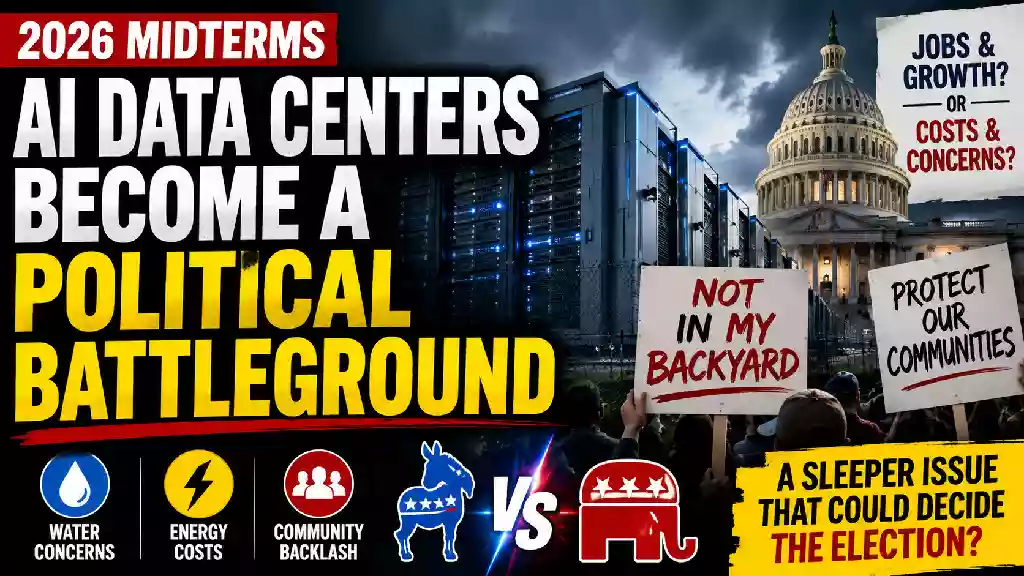
AI data centers are emerging as an unexpected political battleground ahead of the 2026 midterm elections, as communities raise concerns about water use, energy costs and local development while politicians debate the industry's economic benefits.
Data Center Backlash Puts AI Energy and Local Communities at the Center of the 2026 Election
AI Data Centers Turn Into a 2026 Midterm Election Battleground
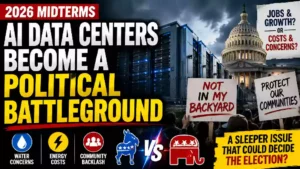
Artificial intelligence data centers are quickly becoming an unexpected political flashpoint ahead of the 2026 midterm elections. Once embraced by politicians as engines of economic growth, job creation and technological advancement, large data center projects are now facing growing opposition from communities concerned about water use, electricity costs, environmental impacts and the character of their neighborhoods.
The political shift is significant. As voters increasingly voice concerns about data center development, candidates from both major parties are being forced to reconsider how closely they want to associate themselves with the rapidly expanding AI industry.
Data Center Opposition Moves Into Election Campaigns
The backlash against data centers has intensified throughout 2026, turning what was once largely an economic development discussion into an increasingly important campaign issue.
Candidates seeking reelection are facing criticism over their connections to data center projects, while opponents are using those connections in campaign advertising. Some politicians have responded by distancing themselves from projects or taking more critical positions than they previously held.
That change reflects a broader political reality: issues that directly affect local communities can become especially powerful during election season.
For years, politicians frequently promoted data centers because of their potential to bring investment, employment and tax revenue. Now, however, the same developments are being portrayed by some candidates as a source of problems for residents.
Water and Electricity Concerns Fuel Community Backlash
Much of the opposition is focused on the local costs associated with large-scale data center development.
Residents have raised concerns about water consumption, electricity demand and potential increases in energy costs. Others object to the size and appearance of the facilities or simply do not want them located near their homes. The debate has increasingly taken on the familiar “not in my backyard” dynamic.
Supporters of data centers counter that these facilities can generate jobs and provide significant economic benefits to communities.
President Donald Trump has defended data center development, arguing that the facilities can bring substantial income and are becoming increasingly necessary as artificial intelligence continues to expand.
The disagreement illustrates the challenge facing local and state officials: how to encourage technological and economic development while addressing residents’ concerns about infrastructure and quality of life.
Ohio Could Become a Key Test of the Issue
The political impact of data centers may be particularly important in Ohio, where the issue has entered a closely watched Senate contest.
The source material identifies the race between Democrat Sherrod Brown and Republican John Husted as an important battleground. Brown has criticized Husted over his association with data center development, while Brown has also faced scrutiny because of his previous support for bringing data centers into Ohio.
The controversy has attracted the attention of national Republican campaign officials. The National Republican Senatorial Committee reportedly warned that backlash over data centers could hurt Republicans in a critical Senate race and potentially influence how politicians across the country approach the industry.
That makes Ohio more than just a local debate. The state’s election could provide an indication of whether data center opposition has enough political strength to influence candidates elsewhere.
AI Expansion Collides With Local Politics
The political challenge comes at a complicated time for the technology industry.
As artificial intelligence becomes a larger part of the economy, demand for the computing infrastructure needed to support AI systems is also expected to grow. Data centers are therefore becoming an increasingly important part of the country’s technology infrastructure.
But political candidates are facing voters who may be less interested in the national importance of AI than in what a data center means for their own community.
Concerns over water, electricity, environmental effects and development can feel much more immediate to residents than arguments about America’s global position in artificial intelligence. The source material indicates that opposition has increasingly become a grassroots and cultural issue rather than simply a partisan political dispute.
A New Political Test for the AI Industry
The growing backlash could force technology companies and policymakers to rethink how they communicate the benefits of data center development.
In previous years, political arguments in favor of domestic data centers often emphasized America’s need to compete globally in artificial intelligence. The source notes that this message is currently struggling to resonate with voters as opposition to data centers grows.
Whether that sentiment lasts remains uncertain. Public attitudes could change as communities gain more experience with data centers and their economic impact. For candidates facing voters in 2026, however, the immediate political reality is much clearer.
AI data centers are no longer simply a technology story. They have become part of a larger debate over jobs, energy, water, economic development and the future of American communities.
As the midterm elections approach, the question may not simply be whether America should build more AI infrastructure. Increasingly, voters may be asking where those data centers should be built, who should benefit from them and who should bear their local costs.
#AI #DataCenters #ArtificialIntelligence #MidtermElections #Election2026 #USPolitics #AIInfrastructure #TechnologyPolicy #DataCenterBacklash #OhioPolitics #Energy #Water #EconomicDevelopment