Oklahoma GOP Governor Candidates Put Education Reform Front and Center Ahead of Primary
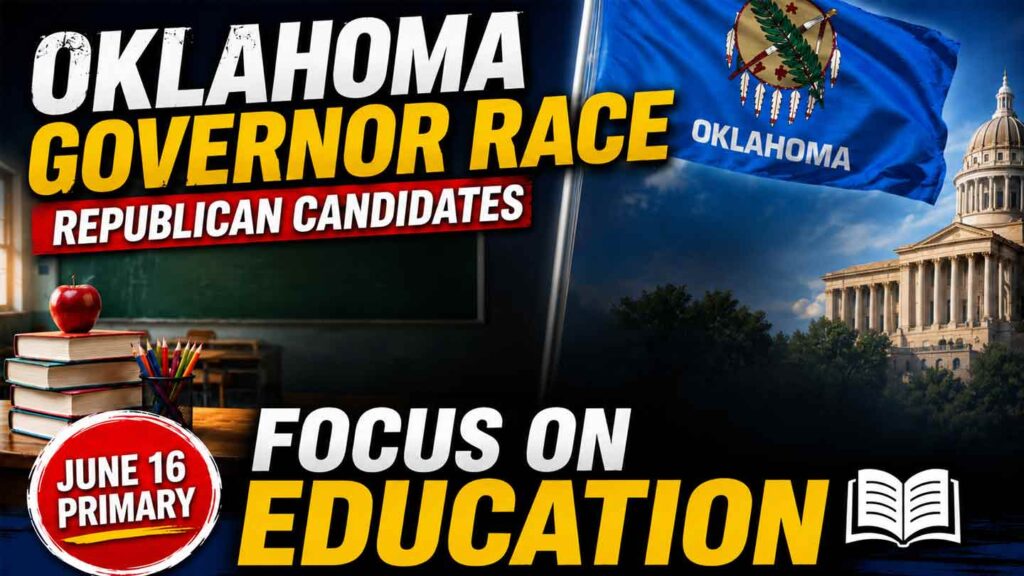
Oklahoma GOP Governor Candidates Put Education Reform Front and Center Ahead of Primary
Literacy School Choice and Classroom Performance Dominate Republican Campaign Discussions
As Oklahoma Republicans prepare to select their nominee for governor, education has emerged as one of the defining issues of the campaign. With Oklahoma frequently ranking near the bottom nationally in education performance metrics, candidates are offering competing visions for improving schools, boosting literacy rates, and preparing students for future success.
The crowded Republican primary field has highlighted concerns over reading proficiency, school choice, curriculum standards, classroom technology, and educational leadership as voters head toward the June primary election. Candidates say improving educational outcomes will be critical to Oklahoma’s long-term economic growth and workforce development.
Drummond Emphasizes Leadership and Early Literacy
Attorney General Gentner Drummond has made education reform a major component of his campaign, arguing that Oklahoma’s educational struggles stem largely from leadership challenges.
Drummond has called for a stronger focus on early childhood literacy and reading proficiency, particularly among younger students. He has expressed support for school choice initiatives but says strengthening public education remains a top priority.
According to Drummond, improving educational outcomes requires sustained leadership rather than short-term policy changes.
“We have to be purposeful to change,” Drummond said during the discussion. “Education is not going to be improved on hope. Education is going to be improved on leadership.”
Keating Highlights Literacy Initiative
Candidate Chip Keating also focused heavily on literacy, pointing to efforts modeled after Mississippi’s widely discussed improvements in reading performance.
Keating argued that Oklahoma has previously implemented successful literacy initiatives but has struggled with long-term consistency. He emphasized the importance of maintaining educational reforms over multiple years rather than abandoning programs before results can be fully measured.
Supporters of literacy-focused reforms often point to third-grade reading proficiency as a key indicator of future academic success.
Mazzei Calls for Curriculum Changes
Trump-endorsed candidate Mike Mazzei said Oklahoma should take a more aggressive approach toward literacy instruction.
Mazzei stated that if elected, he would direct the Oklahoma State Department of Education to review reading curriculum standards and place greater emphasis on phonics-based instruction.
Phonics-based learning has become a central topic in education debates nationwide, with advocates arguing that systematic phonics instruction improves reading outcomes, particularly for younger students and struggling readers.
Mitchell-Haynes Focuses on Reading Fundamentals
Candidate Lisa Mitchell-Haynes also identified literacy and reading instruction as major priorities.
Mitchell-Haynes criticized Oklahoma’s education performance and argued that stronger reading fundamentals are necessary to improve student achievement.
She expressed support for expanded phonics instruction and voiced concerns about current educational outcomes.
Education experts across the country continue to debate the balance between phonics-based approaches and other reading instruction methods, making literacy reform a prominent campaign issue.
Sturgill Supports Classroom Technology Restrictions
Candidate Ken Sturgill highlighted another growing issue in education policy: student cell phone use in schools.
Sturgill expressed support for recent efforts to limit classroom distractions by reducing phone usage during instructional time. Supporters of such policies argue that minimizing distractions can improve student engagement, academic performance, and classroom behavior.
The debate over technology use in schools has gained momentum nationwide as educators seek ways to balance learning opportunities with potential distractions.
McCall Highlights Education Funding and School Choice
Former Oklahoma House Speaker Charles McCall pointed to his legislative record when discussing education.
McCall noted that education funding increased significantly during his time in legislative leadership and highlighted his support for expanded school choice options.
School choice remains one of the most debated topics in Oklahoma politics, with supporters arguing it provides families with greater flexibility while critics express concerns about its impact on traditional public schools.
Other Candidates Offer Broader Perspectives
Candidates Jake Merrick and Caleb Anthony Taylor did not focus heavily on education during the interviews discussed in the report but emphasized their desire to bring different leadership styles to state government.
Both candidates stressed accountability, constitutional principles, and representation for rural Oklahoma communities.
Republican candidate Jennifer Domenico did not participate in the interviews referenced in the report.
Education Expected to Remain Key Election Issue
As the Republican primary approaches, education is expected to remain one of the most closely watched issues in the race.
Whether the discussion centers on literacy initiatives, phonics instruction, school choice, classroom technology, or education funding, candidates agree that improving educational outcomes is critical to Oklahoma’s future.
For many voters, the candidate who presents the most convincing plan to improve schools may ultimately gain a decisive advantage in one of the state’s most competitive gubernatorial primaries in recent years.
#OklahomaPolitics #GovernorRace #OklahomaEducation #EducationReform #SchoolChoice #Literacy #Phonics #GentnerDrummond #MikeMazzei #ChipKeating #CharlesMcCall #KenSturgill